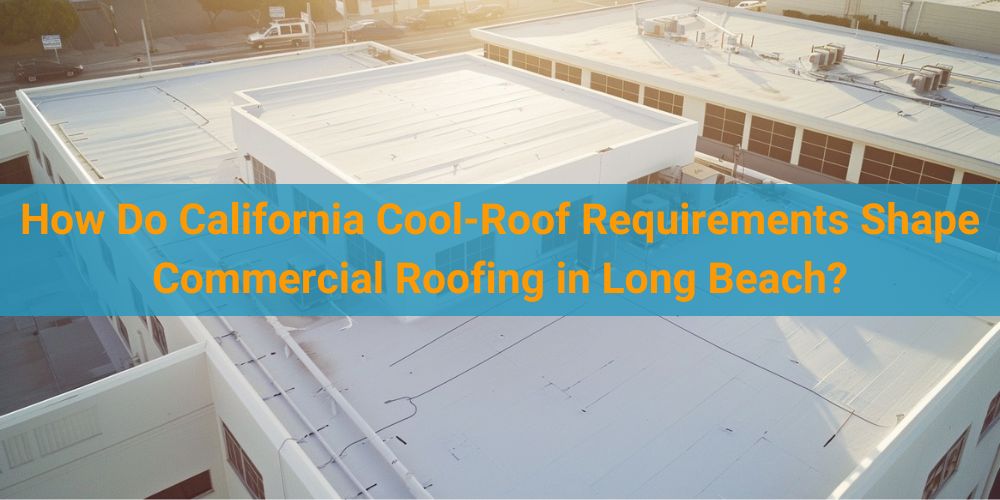
California cool-roof requirements shape commercial roofing in Long Beach by making roof reflectivity, thermal emittance, product rating, roof slope, climate zone, permit scope, insulation strategy, and replacement threshold part of the commercial roof decision. Commercial Roofing Long Beach manages commercial roofing as both a waterproofing system and an energy-code-sensitive exterior asset where the roof must control water intrusion, UV exposure, heat absorption, coastal moisture, salt-air deterioration, rooftop equipment stress, drainage pressure, and long-term roof assembly performance. Cool-roof compliance must be coordinated with roof durability because a reflective roof surface still fails if the underlying roof assembly cannot manage water, wind, moisture, equipment load, or coastal exposure. Cool-roof requirements affect flat and low-slope commercial roofs, TPO roofing, PVC roofing, EPDM roofing, modified bitumen roofing, built-up roofing, metal roofing, coated roof assemblies, roof recover projects, commercial roof replacements, and coating-based restoration work where the roofing product, surface colour, reflectance value, thermal emittance, Solar Reflectance Index, and CRRC rating may influence whether the selected system is appropriate for the project.
In Long Beach, cool-roof planning must account for the city’s split climate-zone profile, with areas south of the 405 Freeway falling in one California climate zone and areas north of the 405 Freeway falling in another. That matters because California Energy Code requirements can depend on building type, roof slope, climate zone, new construction status, alteration scope, reroofing area, roof assembly design, and whether the project follows a prescriptive or performance compliance pathway. A commercial roof in Downtown Long Beach, Belmont Shore, Terminal Island, San Pedro, Signal Hill, Lakewood, or port-adjacent industrial corridors may require different planning considerations depending on the building location, roof type, occupancy, exposure conditions, existing assembly, and whether the work involves coating, recover, partial replacement, or full commercial roof replacement. Commercial Roofing Long Beach evaluates cool-roof implications alongside membrane condition, seam integrity, flashing continuity, drainage behaviour, insulation condition, cover board stability, rooftop equipment layout, coastal exposure, and remaining service life so the roof is not treated as a simple surface colour decision.
California cool-roof requirements shape commercial roofing in Long Beach because roof compliance, energy performance, solar reflectance, thermal emittance, waterproofing durability, coastal exposure, and roof assembly viability must be assessed together before repair, coating, restoration, recover, or replacement is selected.
- Cool-roof compliance as a roofing decision point → California cool-roof rules can affect commercial roofing when a roof is newly installed, replaced, recovered, or altered under a qualifying permit scope → roof colour, reflectivity, thermal emittance, aged solar reflectance, SRI value, roof slope, building category, and climate zone may determine whether a roofing product supports the required compliance pathway → Commercial Roofing Long Beach reviews the roof scope before recommending a membrane, coating, recover, or replacement system → the selected roof solution supports both waterproofing performance and code-sensitive roof planning.
- CRRC-rated product selection → cool-roof compliance depends on documented product performance rather than a generic claim that a roof is white, reflective, or energy efficient → roofing products used for compliance may need listed solar reflectance and thermal emittance values from the Cool Roof Rating Council → Commercial Roofing Long Beach considers CRRC-rated membranes, coatings, or roof surfacing options where cool-roof compliance is relevant → product selection is based on verifiable performance data rather than visual appearance alone.
- Long Beach climate-zone sensitivity → Long Beach includes different California climate-zone conditions on opposite sides of the 405 Freeway → climate-zone classification can affect the applicable energy-code pathway for roofing work → Commercial Roofing Long Beach treats project location as part of the roofing assessment, especially for commercial reroofing, recover, coating, or replacement work → the roof is evaluated according to its actual Long Beach location rather than a generic Southern California assumption.
- Low-slope commercial roof impact → many Long Beach commercial and industrial buildings use flat or low-slope roof systems where cool-roof requirements are especially relevant → TPO, PVC, coated modified bitumen, coated built-up roofing, metal roof coatings, foam roofing, and reflective coating systems may be considered where the roof assembly is suitable → Commercial Roofing Long Beach evaluates slope, drainage, ponding exposure, substrate condition, and coating or membrane compatibility before selecting a cool-roof pathway → reflectivity is integrated into a functional roof system rather than applied as a standalone surface upgrade.
- Reflectivity and heat-gain control → cool-roof systems are designed to reflect more sunlight and absorb less heat than conventional dark roof surfaces → reduced heat absorption can support lower roof surface temperatures, improved interior comfort, and better roof surface performance where the building and roof assembly are suitable → Commercial Roofing Long Beach considers reflective membranes, acrylic coatings, silicone coatings, elastomeric coatings, urethane coatings, and other compatible roof surfaces according to roof type and exposure conditions → roof surface performance is managed as part of long-term commercial building protection.
- Waterproofing remains the first performance requirement → a cool roof that meets reflectance targets can still fail if seams, flashings, penetrations, drains, curbs, roof edges, or substrate conditions are weak → Long Beach commercial roofs must resist coastal moisture, seasonal rain, ponding stress, rooftop HVAC activity, wind exposure, and service traffic as well as solar heat → Commercial Roofing Long Beach evaluates waterproofing details before prioritising reflectivity alone → cool-roof compliance is paired with leak control, drainage performance, and roof assembly durability.
- Coating suitability versus replacement → reflective roof coatings may help support cool-roof performance where the existing roof remains dry, stable, cleanable, and coating-compatible → coating an end-of-life roof, saturated assembly, unstable substrate, or severely ponded system can conceal failure instead of creating a reliable cool roof → Commercial Roofing Long Beach checks adhesion, moisture presence, prior coating condition, drainage behaviour, substrate stability, and roof system compatibility before recommending coating → cool-roof coating is used where it can restore performance rather than mask deeper roof failure.
- Insulation and roof assembly coordination → cool-roof planning does not replace the need to evaluate insulation, cover board, roof deck condition, and thermal continuity → commercial reroofing may require decisions about insulation replacement, tapered insulation, recover board, moisture removal, deck repair, or energy-performance trade-offs → Commercial Roofing Long Beach assesses the roof assembly beneath the surface before selecting a compliant or energy-conscious roofing option → the final roof system supports reflectivity, waterproofing, and assembly stability together.
- Coastal exposure and reflectivity loss → Long Beach roofs face marine-layer moisture, coastal residue, salt air, airborne grime, port-adjacent contaminants, rooftop traffic, and service activity that can reduce reflectivity over time → a roof that starts with strong reflective performance may lose effectiveness if dirt accumulation, coating wear, chemical exposure, or surface degradation is ignored → Commercial Roofing Long Beach considers cleaning access, maintenance planning, coating durability, membrane selection, and rooftop equipment zones during cool-roof planning → reflective performance is treated as a maintainable roof asset rather than a one-time installation feature.
- Rooftop equipment and penetration coordination → HVAC units, exhaust fans, service lines, vents, skylights, hatches, pipe supports, walk paths, and equipment platforms interrupt reflective roof surfaces and create leak-prone areas → cool-roof work that ignores these details may leave the building vulnerable even if the field membrane or coating is compliant → Commercial Roofing Long Beach integrates curbs, penetrations, flashing transitions, walk pads, equipment clearances, and service-access protection into the cool-roof plan → reflectivity, waterproofing, and rooftop service durability are managed as one roof system.
- Replacement threshold and scope planning → cool-roof requirements may become relevant when the project scope reaches a qualifying reroof, replacement, recover, or alteration threshold → partial work, full replacement, roof recover, coating restoration, and phased commercial roofing projects should be reviewed before materials are selected → Commercial Roofing Long Beach evaluates whether the roof scope triggers cool-roof planning and whether the existing assembly can support the intended system → project scope is defined before the owner commits to a repair, coating, recover, or replacement pathway.
- Documentation and inspection readiness → cool-roof compliance depends on product identification, rated values, permit documentation, and installation consistency, not just the contractor’s description of the roof surface → missing labels, unclear product data, incompatible materials, or undocumented substitutions can create compliance and closeout problems → Commercial Roofing Long Beach treats product selection, roof documentation, coating or membrane data, and final installation review as part of the roofing process → the completed roof is easier to document, inspect, maintain, and manage over its service life.
Commercial Roofing Long Beach manages California cool-roof requirements as part of complete commercial roof planning, not as a disconnected energy-code checkbox. By assessing roof location, climate-zone relevance, roof slope, permit scope, product rating, solar reflectance, thermal emittance, SRI value, membrane type, coating compatibility, insulation condition, drainage behaviour, rooftop equipment layout, coastal exposure, moisture evidence, substrate stability, and remaining service life together, Commercial Roofing Long Beach helps Long Beach commercial properties select roofing systems that support waterproofing, energy-conscious performance, code-sensitive planning, and long-term roof asset value.
How Do Cool-Roof Requirements Affect Commercial Roof System Selection in Long Beach?
Cool-roof requirements affect commercial roof system selection in Long Beach by changing how Commercial Roofing Long Beach evaluates membranes, coatings, surfacing, insulation, drainage, attachment, rooftop equipment areas, and long-term maintenance needs before recommending a roofing pathway. A roof system cannot be selected only because it appears reflective or meets a single product-rating target. The selected commercial roof must also remain watertight, compatible with the existing assembly, suitable for the building’s slope and drainage conditions, resistant to coastal exposure, and appropriate for the property’s operational use. In Long Beach, cool-roof system selection must account for marine-layer moisture, salt air, strong UV exposure, seasonal rain, rooftop HVAC activity, port-adjacent residue, service traffic, and low-slope drainage pressure.
Commercial Roofing Long Beach evaluates cool-roof system selection according to roof type, climate-zone relevance, permit scope, product rating, solar reflectance, thermal emittance, SRI value, substrate stability, moisture presence, coating compatibility, membrane condition, insulation strategy, roof slope, drainage behaviour, rooftop equipment layout, and remaining service life. This determines whether the correct path is reflective TPO roofing, PVC roofing, coated modified bitumen, coated built-up roofing, metal roof coating, foam roofing with protective coating, elastomeric coating, silicone coating, acrylic coating, urethane coating, roof recover, partial replacement, or full commercial roof replacement. Cool-roof compliance is therefore handled as part of complete roof system design, not as a surface-level product choice.
Commercial Roofing Long Beach selects cool-roof systems by balancing compliance, reflectivity, waterproofing durability, coastal exposure resistance, drainage performance, assembly condition, and long-term roof asset value.
- TPO roofing selection → TPO roofing is often considered for reflective low-slope commercial roof applications because it can provide a light-coloured thermoplastic membrane surface with heat-welded seams → selection still depends on weld quality, attachment method, cover board condition, insulation stability, rooftop equipment exposure, drainage behaviour, and perimeter securement → Commercial Roofing Long Beach evaluates whether TPO supports both cool-roof objectives and single-ply waterproofing requirements → the roof system is selected for reflectivity and roof assembly performance together.
- PVC roofing selection → PVC roofing may support cool-roof planning where a reflective single-ply membrane is needed alongside chemical resistance, grease exposure resistance, and heat-welded seam performance → restaurants, industrial facilities, port-adjacent properties, and rooftop-exhaust-heavy buildings may require additional review of chemical exposure zones and membrane compatibility → Commercial Roofing Long Beach evaluates PVC membrane condition, weld integrity, drainage pressure, flashing details, and rooftop discharge risk → the selected roof system supports reflectivity, chemical resistance, and long-term waterproofing.
- EPDM roofing and reflective upgrade decisions → EPDM roofing may require special cool-roof planning where the existing dark membrane does not provide the required reflective surface for a qualifying scope → coating, recover, or replacement may be considered depending on membrane condition, adhesive stability, seam tape performance, moisture status, and substrate viability → Commercial Roofing Long Beach determines whether the roof can be restored with a compatible reflective coating or whether a different replacement system is more appropriate → compliance planning is matched to the actual condition of the EPDM assembly.
- Modified bitumen and built-up roofing selection → modified bitumen and built-up roof systems may need reflective surfacing, coating, cap sheet selection, or replacement planning where cool-roof requirements apply → surface ageing, granule loss, blistering, ponding water, open seams, flashing wear, and trapped moisture can prevent reliable coating or recovery → Commercial Roofing Long Beach evaluates whether reflective coating, reinforced restoration, recover, or full replacement is the correct pathway → asphalt-based roof systems are upgraded only where the existing assembly can support the selected cool-roof solution.
- Metal roof coating selection → metal commercial roofs may support cool-roof performance through reflective coating where panels, fasteners, laps, sealants, flashings, and corrosion-prone details remain viable → salt air, coastal condensation, oxidation, fastener back-out, panel movement, and rooftop equipment exposure can weaken the roof before coating is applied → Commercial Roofing Long Beach reviews rust, adhesion, fastener condition, panel stability, drainage behaviour, and coating compatibility before specifying a reflective metal roof coating → cool-roof performance is paired with corrosion control and leak prevention.
- Foam roofing and protective coating selection → foam roofing can support cool-roof objectives when the SPF system is protected by a suitable reflective coating and the foam remains dry, bonded, and stable → exposed foam, coating erosion, moisture intrusion, blistering, soft areas, or adhesion failure can make recoating unreliable → Commercial Roofing Long Beach evaluates foam density, coating thickness, moisture status, drainage behaviour, UV exposure, and rooftop traffic before recommending recoat, restoration, partial replacement, or full replacement → reflective performance is preserved only where the foam roof assembly remains viable.
- Reflective coating system selection → acrylic, silicone, elastomeric, and urethane coatings can support cool-roof planning where the existing roof is clean, dry, stable, compatible, and properly prepared → coating selection depends on ponding exposure, adhesion profile, surface contamination, prior coating condition, roof type, chemical exposure, and rooftop equipment stress → Commercial Roofing Long Beach tests coating suitability before recommending a reflective restoration system → coating is used where it can improve roof performance rather than conceal saturated or failing roof materials.
- Insulation and cover board coordination → cool-roof system selection does not remove the need to evaluate insulation, cover board, recovery board, tapered insulation, roof deck condition, and moisture content → wet insulation, crushed boards, poor fastening, deck deterioration, or trapped moisture can undermine the new reflective surface → Commercial Roofing Long Beach evaluates the roof assembly below the membrane or coating before selecting a cool-roof pathway → the final system supports reflectivity, waterproofing, thermal performance, and assembly stability.
- Drainage and ponding compatibility → reflective membranes and coatings must still withstand the actual drainage behaviour of the roof → blocked drains, restricted scuppers, shallow slope, water-retaining areas, and seasonal rain exposure can shorten coating life, stress seams, and increase leak risk → Commercial Roofing Long Beach reviews drainage before selecting coating chemistry, membrane type, reinforcement scope, or replacement design → the cool-roof system is matched to real low-slope roof conditions rather than selected only for reflectivity.
- Recover versus full replacement selection → cool-roof requirements may influence whether a property owner considers recover, coating restoration, partial replacement, or full replacement → recover may be viable where the existing assembly is dry, stable, code-compliant, compatible, and structurally sound, while full tear-off may be required where moisture saturation, substrate instability, multiple roof layers, or deck damage is present → Commercial Roofing Long Beach compares recover viability against roof condition and compliance needs → the selected pathway supports long-term roof performance instead of short-term surface compliance.
Commercial Roofing Long Beach approaches cool-roof system selection as a complete commercial roofing decision, not a surface-colour choice. By evaluating California Energy Code relevance, CRRC-rated product data, membrane type, coating chemistry, product rating, solar reflectance, thermal emittance, SRI value, insulation strategy, roof slope, drainage behaviour, coastal exposure, rooftop equipment layout, moisture evidence, substrate condition, recover viability, and replacement scope together, Commercial Roofing Long Beach helps Long Beach commercial properties select roof systems that support cool-roof planning, waterproofing reliability, energy-conscious performance, code-sensitive documentation, and long-term roof asset protection.
Have a question about a commercial roofing project?
When Do Cool-Roof Requirements Affect Repair, Coating, Recover, or Replacement Decisions?
Cool-roof requirements affect repair, coating, recover, and replacement decisions when the commercial roofing scope moves beyond isolated maintenance and begins to change the roof surface, roof assembly, reflective performance, insulation strategy, or permit-triggered reroofing condition. In Long Beach, Commercial Roofing Long Beach evaluates whether a roof can remain in a targeted repair pathway, whether reflective coating can restore performance, whether recover is viable, whether partial replacement can isolate failed roof zones, or whether full commercial roof replacement is required. The decision depends on roof condition, moisture presence, substrate stability, roof slope, drainage behaviour, existing roof layers, product rating, California Energy Code relevance, CRRC-rated material data, coastal exposure, rooftop equipment layout, and remaining service life.
A cool-roof decision is not automatically a replacement decision. Some commercial roofs only require localised repair where the affected area is small, the roof assembly remains dry, and the work does not create a broader reroofing or coating scope. Other roofs may be candidates for reflective coating, reinforced restoration, recover, partial replacement, or full tear-off depending on the condition of the membrane, seams, flashings, insulation, cover board, roof deck, drainage paths, and rooftop equipment zones. Commercial Roofing Long Beach separates these pathways so a property owner does not apply a reflective coating to a failing roof, replace a roof that could still be restored, or miss a compliance issue when the project scope reaches a qualifying threshold.
Commercial Roofing Long Beach evaluates cool-roof decisions by connecting code-sensitive scope, roof condition, assembly viability, waterproofing risk, and long-term asset performance before repair, coating, recover, or replacement is selected.
- Targeted repair pathway → isolated punctures, minor flashing defects, small seam openings, limited rooftop equipment leaks, or localised membrane damage may remain in a repair pathway where the surrounding roof assembly is dry, stable, and serviceable → cool-roof requirements may have limited impact when the work does not alter the broader roof surface or trigger a qualifying reroofing scope → Commercial Roofing Long Beach confirms roof condition, leak source, material compatibility, and repair limits before work is selected → local defects are corrected without misclassifying the project as a coating, recover, or replacement scope.
- Reflective coating pathway → worn roof surfaces, reduced reflectivity, coating ageing, minor waterproofing decline, seam stress, fastener exposure, and UV-related surface wear may point toward reflective coating where the roof remains dry, stable, cleanable, and coating-compatible → coating can support cool-roof performance only when adhesion, moisture status, drainage behaviour, surface preparation, roof type, and product rating are suitable → Commercial Roofing Long Beach evaluates acrylic, silicone, elastomeric, urethane, or other compatible reflective coating options according to the existing roof assembly → coating is used to restore surface performance where the roof remains viable rather than conceal deeper failure.
- Restoration pathway → some commercial roofs need more than coating but less than full replacement when seams, flashings, penetrations, fasteners, drains, or rooftop equipment zones require reinforcement before a reflective surface is installed → restoration may include cleaning, priming, seam treatment, flashing correction, fabric reinforcement, fastener sealing, drain-area repair, and compatible coating application → Commercial Roofing Long Beach determines whether restoration can improve waterproofing, reflectivity, and service life while supporting cool-roof planning → the roof is upgraded as a connected assembly instead of receiving a surface-only coating.
- Recover pathway → roof recover may be considered when the existing roof assembly is dry, stable, compatible, structurally sound, and able to receive a new compliant roof layer without full tear-off → cool-roof requirements can influence the membrane, surfacing, insulation, cover board, and product-rating choices used in the recover design → Commercial Roofing Long Beach evaluates existing roof layers, moisture evidence, attachment stability, deck condition, slope, drainage, and code-sensitive project scope before recommending recover → recover is used only where the existing roof can support a new roof system without trapping hidden failure.
- Partial replacement pathway → partial replacement may be appropriate where one roof section has saturated insulation, repeated leaks, drainage damage, failed seams, or rooftop equipment-related deterioration while the remaining roof areas are still serviceable → cool-roof planning must still account for product compatibility, transition details, reflectivity, thermal emittance, and how the new section ties into the existing roof assembly → Commercial Roofing Long Beach evaluates leak distribution, moisture spread, section boundaries, roof transitions, and compliance implications before isolating the replacement area → failed zones are renewed without unnecessarily replacing roof areas that remain viable.
- Full replacement pathway → full commercial roof replacement becomes the correct pathway when moisture saturation, unstable substrate, widespread membrane failure, repeated leaks, severe ponding, multiple failed roof layers, deck deterioration, or end-of-life conditions make repair, coating, restoration, or recover unreliable → cool-roof requirements then become part of the replacement design through membrane selection, insulation strategy, reflectivity, thermal emittance, SRI value, CRRC-rated product data, drainage planning, and permit documentation → Commercial Roofing Long Beach selects a replacement system around both roof performance and code-sensitive planning → the new roof supports waterproofing reliability, energy-conscious performance, and long-term roof asset value.
- Moisture and substrate boundary → the boundary between coating, recover, partial replacement, and full replacement is often determined by moisture presence and substrate stability → wet insulation, soft areas, blistering, delamination, deck deterioration, trapped water, or unstable cover board can make surface-level cool-roof work unreliable → Commercial Roofing Long Beach evaluates concealed moisture and assembly condition before selecting a reflective roof pathway → cool-roof work is not installed over hidden roof failure that would shorten service life.
- Drainage and ponding boundary → low-slope commercial roofs in Long Beach must manage seasonal rain, shallow slope, blocked drains, restricted scuppers, clogged gutters, and water-retaining areas before a coating, recover, or replacement system is selected → ponding conditions can affect coating chemistry, membrane selection, reinforcement scope, insulation design, and replacement planning → Commercial Roofing Long Beach evaluates drainage behaviour as part of the cool-roof decision → reflective performance is paired with water-control planning rather than treated as a substitute for drainage correction.
- Coastal exposure boundary → marine-layer moisture, salt air, coastal residue, port-adjacent contaminants, rooftop service traffic, and equipment discharge can reduce reflectivity, weaken adhesion, corrode metal details, contaminate repair surfaces, and shorten coating life → cool-roof decisions must account for the actual exposure profile of the building → Commercial Roofing Long Beach reviews surface cleanliness, corrosion-prone components, rooftop equipment zones, chemical exposure, and maintenance access before selecting repair, coating, recover, or replacement → the selected pathway is matched to Long Beach coastal conditions.
- Documentation and closeout pathway → when cool-roof requirements are relevant, the project may need product documentation, rated values, installation consistency, permit support, and closeout records → undocumented substitutions, unclear coating data, missing product ratings, or mismatched materials can create compliance and maintenance problems → Commercial Roofing Long Beach treats documentation as part of the roofing pathway, especially for coating, recover, partial replacement, and full replacement work → the completed roof is easier to inspect, maintain, verify, and manage over its service life.
Commercial Roofing Long Beach determines whether cool-roof requirements affect repair, coating, recover, or replacement by assessing the actual roof scope and the condition of the full roof assembly. By reviewing leak source, roof system type, membrane condition, moisture profile, substrate stability, drainage behaviour, coastal exposure, insulation condition, rooftop equipment layout, product rating, California Energy Code relevance, CRRC-rated material data, recover viability, and replacement threshold together, Commercial Roofing Long Beach helps Long Beach commercial properties choose a roofing pathway that supports compliance-sensitive planning, waterproofing durability, energy-conscious performance, and long-term commercial roof asset protection.
How Do Cool-Roof Details Affect Long Beach Commercial Roof Performance?
Cool-roof details affect Long Beach commercial roof performance because reflective membranes, coatings, seams, flashings, penetrations, roof edges, drains, scuppers, gutters, insulation, cover boards, rooftop equipment zones, and product documentation must work together for the roof to perform as more than a reflective surface. A cool roof can support lower heat absorption and energy-conscious performance, but it still fails as a commercial roof if detail areas allow water intrusion, coating separation, seam failure, drainage stress, rooftop equipment damage, or coastal deterioration. Commercial Roofing Long Beach evaluates cool-roof details as performance control points because each detail determines whether the roof can preserve reflectivity, waterproofing reliability, code-sensitive documentation, and long-term roof assembly value under Long Beach exposure conditions.
In Long Beach, cool-roof detail performance is shaped by marine-layer moisture, salt air, strong UV exposure, seasonal rain, rooftop HVAC activity, service traffic, port-adjacent residue, low-slope drainage pressure, and coastal contaminants that can reduce reflectivity, weaken adhesion, corrode metal components, contaminate repair surfaces, and accelerate deterioration around vulnerable roof zones. Commercial Roofing Long Beach reviews detail areas before recommending reflective coating, cool-roof membrane installation, recover, partial replacement, or full commercial roof replacement. This ensures the selected cool-roof pathway is supported by stable seams, watertight flashings, compatible surfaces, controlled drainage, protected roof edges, reinforced equipment zones, and documentation-ready material choices.
Commercial Roofing Long Beach treats cool-roof details as the connection between California cool-roof planning and real commercial roof performance because reflectivity only matters when the roof assembly remains watertight, durable, maintainable, and suitable for Long Beach conditions.
- Reflective membrane details → TPO, PVC, reflective modified bitumen, coated built-up roofing, metal roof coatings, and other cool-roof surfaces rely on continuous field performance and properly formed details → seams, laps, welds, terminations, transitions, and tie-ins can weaken the reflective roof system if they are poorly installed, aged, contaminated, or exposed to ponding water → Commercial Roofing Long Beach reviews membrane detail condition before selecting repair, recover, coating, or replacement → reflective roof performance is tied to waterproofing continuity rather than surface colour alone.
- Coating adhesion details → reflective roof coatings depend on clean, dry, compatible, and properly prepared surfaces to bond correctly → salt residue, coastal grime, chalking, oxidation, grease, previous coating failure, trapped moisture, or contaminated roof areas can cause peeling, blistering, delamination, or premature coating breakdown → Commercial Roofing Long Beach evaluates adhesion risk, surface preparation needs, primer requirements, prior coating condition, and roof material compatibility before coating work is recommended → the cool-roof coating performs as a restoration layer rather than a temporary surface film.
- Seams, laps, and weld continuity → cool-roof membranes still depend on watertight seams, bonded laps, heat-welded joints, reinforced transitions, and compatible repair edges → UV exposure, thermal movement, rooftop traffic, ponding water, installation defects, or prior patching can weaken seam continuity and create hidden water-entry routes → Commercial Roofing Long Beach inspects, probes, repairs, reinforces, or replaces seam areas where required → linear leak pathways are controlled before they undermine the wider cool-roof assembly.
- Flashing and roof-to-wall transitions → parapets, coping systems, counterflashing, wall transitions, expansion joints, edge metal, and termination details connect the cool roof to the wider building envelope → wind exposure, ageing sealants, salt-air deterioration, thermal movement, and poor detailing can open these transitions even when the roof field remains reflective → Commercial Roofing Long Beach evaluates roof-to-wall continuity before treating a roof as coating-ready, recover-ready, or replacement-ready → perimeter leaks, moisture tracking, and transition failures are reduced.
- Penetrations and rooftop equipment zones → HVAC curbs, exhaust fans, vents, pipes, conduits, skylights, hatches, service platforms, walk paths, and equipment supports interrupt cool-roof surfaces and concentrate wear → vibration, technician access, equipment discharge, grease exposure, and foot traffic can damage coatings, membranes, flashings, and sealants around these areas → Commercial Roofing Long Beach reinforces, re-flashes, repairs, protects, or replaces vulnerable equipment-zone details before the cool-roof system is finalized → rooftop equipment areas remain integrated into the roof system instead of becoming recurring leak points.
- Drainage and ponding details → reflective coatings and membranes must still manage water around drains, scuppers, gutters, crickets, saddles, low points, and ponding-prone areas → blocked drainage, shallow slope, restricted outlets, debris accumulation, or water-retaining roof zones can shorten coating life, stress seams, reduce adhesion, and increase leak risk → Commercial Roofing Long Beach evaluates drainage behaviour before recommending a coating, recover, restoration, or replacement pathway → cool-roof performance is supported by water-control planning rather than reflectivity alone.
- Roof edges and perimeter securement → cool-roof systems must remain secure at roof edges, corners, parapets, fascia lines, terminations, fasteners, plates, adhesives, coping systems, and edge-metal details → Pacific wind exposure, salt air, coastal moisture, loose metal, ageing attachment, and rooftop movement can weaken perimeter performance → Commercial Roofing Long Beach reviews edge securement and perimeter condition before selecting the cool-roof pathway → uplift movement, edge-related leaks, and premature perimeter failure are reduced.
- Insulation, cover board, and substrate details → cool-roof performance depends on the roof assembly beneath the reflective surface, including insulation, cover board, recovery board, substrate, and roof deck condition → wet insulation, crushed cover board, soft areas, trapped moisture, unstable substrate, or deck deterioration can undermine a reflective membrane or coating → Commercial Roofing Long Beach evaluates hidden assembly layers before recommending coating, recover, partial replacement, or full replacement → the cool-roof surface is supported by a stable roof assembly.
- Walk paths and maintenance-access details → reflective roof surfaces can be damaged by maintenance traffic, dropped tools, service access, rooftop equipment repair, and repeated movement across the same routes → coating wear, membrane abrasion, punctures, and seam stress often develop near access points and mechanical equipment → Commercial Roofing Long Beach considers walk pads, reinforced access routes, coating thickness, and equipment-zone protection where required → long-term cool-roof performance is protected in high-traffic roof areas.
- Product documentation and closeout details → cool-roof planning may require product identification, CRRC-rated material data, solar reflectance values, thermal emittance values, SRI information, coating specifications, membrane documentation, and installation records → missing product data, undocumented substitutions, or unclear coating systems can create compliance and maintenance uncertainty → Commercial Roofing Long Beach treats documentation as part of the cool-roof detail package → the completed roof is easier to verify, inspect, maintain, and manage over its service life.
Commercial Roofing Long Beach protects cool-roof performance by treating details as the parts of the roof where compliance, reflectivity, waterproofing, coastal exposure, and maintenance reality meet. By evaluating membranes, coatings, seams, flashings, penetrations, drains, scuppers, gutters, roof edges, rooftop equipment areas, insulation, cover boards, substrates, walk paths, adhesion conditions, product documentation, and remaining service life together, Commercial Roofing Long Beach helps Long Beach commercial properties avoid cool-roof choices that look compliant at the surface but fail at the roof details that control long-term performance.
How Do Long Beach Coastal Conditions Affect Cool-Roof Performance?
Long Beach coastal conditions affect cool-roof performance by changing how reflective membranes, roof coatings, seams, flashings, drains, roof edges, rooftop equipment zones, insulation, cover boards, and maintenance plans perform after installation. A cool roof is not protected by reflectivity alone. The roof surface must keep its solar-reflective function while also resisting marine-layer moisture, salt air, coastal residue, strong UV exposure, Pacific wind, seasonal rain, port-adjacent contaminants, rooftop HVAC activity, service traffic, and low-slope drainage pressure. Commercial Roofing Long Beach evaluates cool-roof performance as a coastal roof asset issue because a reflective roof surface can lose value if it becomes dirty, contaminated, poorly bonded, ponding-stressed, corroded at details, or weakened around equipment and penetrations.
In Long Beach, cool-roof performance must be assessed differently than in a dry inland environment because commercial roofs near coastal, marine-adjacent, port-adjacent, logistics, restaurant, industrial, retail, office, and multi-tenant settings face multiple exposure pressures at the same time. Salt air can accelerate metal-detail deterioration. Marine-layer moisture can keep surfaces damp for longer periods. Coastal grime and port-adjacent residue can reduce reflectivity. Seasonal rain can expose drainage weaknesses. Rooftop HVAC activity and service traffic can wear down coatings, membranes, and walk paths. These conditions affect whether the correct cool-roof strategy is maintenance, cleaning, targeted repair, reflective coating, reinforced restoration, recover, partial replacement, or full commercial roof replacement.
Commercial Roofing Long Beach protects cool-roof performance by treating Long Beach coastal exposure as a direct roof performance factor, not as background weather.
These coastal exposure checks are what make cool-roof planning practical in Long Beach, because California cool-roof relevance only creates value when the selected roof system can preserve reflectivity, waterproofing, adhesion, drainage control, rooftop equipment protection, and roof assembly durability under real coastal commercial conditions.
- Marine-layer moisture and surface dampness → Long Beach marine-layer conditions can keep roof surfaces, seams, coatings, flashings, drains, and penetration areas damp for extended periods → persistent surface moisture can increase adhesion risk, slow coating cure, reveal weak seams, support biological residue, and make minor roof defects more active → Commercial Roofing Long Beach evaluates moisture patterns before recommending reflective coating, membrane repair, recover, or replacement → cool-roof performance is protected by confirming that the roof surface and assembly can manage coastal dampness.
- Salt air and corrosion-prone roof details → salt-laden air can accelerate deterioration around edge metal, fasteners, coping systems, gutters, scuppers, panel laps, equipment supports, exposed steel, flashing terminations, and metal roof components → corroded details can create leak paths or weaken roof securement even when the reflective field surface still appears serviceable → Commercial Roofing Long Beach identifies corrosion-prone details before selecting coating, restoration, recover, or replacement → cool-roof durability is supported by protecting the metal components that hold the roof system together.
- Coastal residue and reflectivity loss → coastal grime, salt residue, port-adjacent contaminants, airborne particles, industrial residue, and rooftop debris can accumulate on reflective membranes and coatings → surface build-up can reduce solar reflectance, obscure membrane condition, interfere with coating adhesion, and shorten the useful life of the cool-roof surface → Commercial Roofing Long Beach considers cleaning access, maintenance frequency, coating durability, surface preparation, and product selection before recommending a cool-roof pathway → reflective performance is treated as a maintainable roof property rather than a permanent condition.
- Strong UV exposure and coating ageing → cool roofs are designed to manage solar exposure, but Long Beach commercial roof surfaces still face sustained UV, heat cycling, and surface weathering → UV exposure can age coatings, embrittle vulnerable materials, fade reflective surfaces, stress seams, and accelerate breakdown where coating thickness or membrane condition is weak → Commercial Roofing Long Beach evaluates coating age, membrane condition, film thickness, surface wear, and remaining service life → cool-roof performance is preserved through repair, recoating, restoration, or replacement before UV-related deterioration becomes system-wide failure.
- Pacific wind and perimeter movement → coastal wind can stress roof edges, parapets, coping systems, terminations, edge metal, fasteners, plates, adhesives, membrane seams, and lightweight rooftop components → movement at these details can weaken the roof assembly and create water-entry points even if the reflective roof field remains intact → Commercial Roofing Long Beach evaluates perimeter securement, roof-to-wall continuity, edge details, and wind-sensitive areas before selecting the cool-roof solution → reflectivity is paired with perimeter stability and wind-resistant roof performance.
- Seasonal rain and low-slope drainage pressure → seasonal rain can expose drainage weaknesses across flat and low-slope commercial roofs with blocked drains, restricted scuppers, clogged gutters, shallow slope, sagging areas, or water-retaining zones → standing water can stress coatings, seams, flashings, patches, penetrations, and reflective membranes → Commercial Roofing Long Beach evaluates drainage behaviour before recommending coating chemistry, membrane repair, recover, restoration, or replacement → cool-roof performance is protected by controlling water movement as well as heat absorption.
- Port-adjacent contaminants and chemical exposure → commercial roofs near port-adjacent, industrial, restaurant, logistics, and service-yard environments may be exposed to exhaust residue, grease, oils, chemical runoff, airborne grime, equipment discharge, and operational debris → contamination can weaken coating adhesion, reduce reflectivity, affect membrane compatibility, and create premature surface degradation → Commercial Roofing Long Beach reviews exposure zones, surface contamination, chemical compatibility, cleaning needs, and repair material suitability before specifying work → cool-roof materials are matched to the actual exposure profile of the property.
- Rooftop HVAC activity and service traffic → HVAC units, exhaust fans, service lines, walk paths, hatches, vents, pipe supports, mechanical platforms, and technician access routes concentrate wear on reflective roof surfaces → foot traffic, vibration, dropped tools, condensate discharge, grease exposure, and equipment repairs can damage coatings, membranes, seams, and flashings → Commercial Roofing Long Beach considers walk pads, equipment-zone reinforcement, curb flashing repair, access-route protection, and coating thickness where needed → cool-roof performance is protected in the areas most likely to experience repeated physical stress.
- Moisture beneath reflective roof systems → coastal exposure can make hidden moisture harder to identify because water may enter through seams, flashings, drains, penetrations, or prior repairs before moving into insulation, cover boards, or substrate layers → installing a reflective coating or new cool-roof surface over trapped moisture can shorten service life and conceal assembly failure → Commercial Roofing Long Beach evaluates soft spots, blistering, staining, delamination, wet insulation indicators, and substrate stability before recommending surface-level work → cool-roof upgrades are selected only where the underlying roof remains viable.
- Maintenance planning for reflective performance → cool-roof performance can decline when reflective surfaces are not cleaned, inspected, repaired, or protected after installation → Long Beach coastal residue, equipment traffic, drainage debris, coating wear, and salt-air deterioration make maintenance planning especially important → Commercial Roofing Long Beach supports cool-roof performance through inspection scheduling, cleaning considerations, drainage checks, coating reviews, seam monitoring, and equipment-zone protection → the roof remains easier to manage as a reflective, waterproofing, and commercial asset over time.
Commercial Roofing Long Beach evaluates Long Beach coastal conditions as part of cool-roof performance because reflectivity, waterproofing, adhesion, drainage, corrosion control, rooftop equipment protection, and roof assembly durability must operate together. By assessing marine-layer moisture, salt air, coastal residue, UV exposure, Pacific wind, seasonal rain, port-adjacent contaminants, rooftop HVAC activity, service traffic, hidden moisture risk, drainage behaviour, coating condition, membrane compatibility, and remaining service life, Commercial Roofing Long Beach helps commercial properties select and maintain cool-roof systems that remain practical under coastal Southern California roof conditions.
Which Long Beach Properties Need Cool-Roof-Aware Commercial Roofing?
Long Beach properties need cool-roof-aware commercial roofing when the roof must support reflective performance, waterproofing reliability, California cool-roof planning, drainage control, rooftop equipment protection, coastal exposure resistance, and long-term commercial roof asset value. Cool-roof-aware roofing is especially relevant for flat and low-slope commercial buildings where roof surface selection, coating suitability, membrane reflectivity, thermal emittance, SRI value, CRRC-rated product data, insulation strategy, permit scope, and replacement threshold can influence the correct roofing pathway. Commercial Roofing Long Beach applies cool-roof-aware commercial roofing to properties where reflective roof performance must be balanced with real roof condition, including moisture status, substrate stability, seam integrity, flashing continuity, drainage behaviour, rooftop equipment layout, coastal residue, salt-air exposure, and remaining service life.
In Long Beach, cool-roof-aware roofing is important across commercial, industrial, warehouse, logistics, retail, office, restaurant, hospitality, flex industrial, multi-tenant, marine-adjacent, and port-adjacent properties because these buildings often combine large roof areas, low-slope drainage sensitivity, rooftop HVAC activity, service traffic, coastal moisture, strong UV exposure, and operational exposure. A building may appear to need a reflective coating, but the correct solution could be targeted repair, reinforced restoration, roof recover, partial replacement, or full commercial roof replacement depending on roof assembly condition. Commercial Roofing Long Beach evaluates each property type according to how the roof protects the building, how the roof surface performs under Long Beach exposure, and whether cool-roof planning can be applied without sacrificing waterproofing durability.
Commercial Roofing Long Beach provides cool-roof-aware commercial roofing where property type, roof use, exposure conditions, code-sensitive planning, and roof assembly condition must be evaluated together before a reflective roof solution is selected.
- Warehouse and logistics buildings → large flat and low-slope roof areas on warehouse and logistics properties can experience high heat gain, long drainage runs, rooftop HVAC demand, service traffic, and inventory-sensitive interior use → cool-roof planning may support reflective performance, but only where seams, drains, scuppers, insulation, cover boards, rooftop equipment zones, and substrate conditions remain viable → Commercial Roofing Long Beach evaluates whether reflective TPO, PVC, roof coating, recover, restoration, partial replacement, or full replacement is the correct pathway → warehouse and logistics roofs remain better protected against heat exposure, leaks, drainage stress, and inventory disruption.
- Industrial and manufacturing buildings → industrial roofs may face rooftop equipment loads, exhaust systems, service platforms, vibration, chemical exposure, mechanical penetrations, heat discharge, and heavy maintenance access → cool-roof-aware roofing must consider membrane durability, coating compatibility, chemical resistance, drainage behaviour, roof detail stress, and rooftop equipment protection before selecting a reflective system → Commercial Roofing Long Beach evaluates roof condition and exposure type before recommending coating, repair, restoration, recover, or replacement → industrial roof performance is improved without treating reflectivity as a substitute for system durability.
- Port-adjacent and marine-adjacent properties → properties near port corridors, marine facilities, Terminal Island, San Pedro, Wilmington, and industrial waterfront areas may face salt air, coastal residue, airborne grime, exhaust deposits, rooftop debris, and corrosion-prone roof details → these conditions can reduce reflectivity, weaken coating adhesion, contaminate repair surfaces, and accelerate metal-detail deterioration → Commercial Roofing Long Beach reviews corrosion risk, surface cleanliness, coating suitability, membrane compatibility, drainage, and maintenance access before selecting the cool-roof pathway → reflective roof performance is matched to coastal and port-adjacent exposure.
- Retail centers and shopping plazas → retail buildings often combine broad roof areas, tenant improvements, HVAC units, signage penetrations, shared drainage routes, customer-facing interiors, and multiple leak-sensitive spaces beneath one roof → cool-roof-aware roofing must protect reflectivity, waterproofing, tenant continuity, flashing performance, and rooftop equipment zones together → Commercial Roofing Long Beach evaluates whether the roof needs repair, reflective coating, restoration, recover, partial replacement, or full replacement before work is specified → retail interiors, tenant spaces, finishes, and customer-facing areas receive stronger roof-side protection.
- Restaurant and food-service properties → restaurant roofs may be exposed to grease exhaust, rooftop discharge, chemical cleaning residue, HVAC activity, condensate lines, exhaust fans, service access, and frequent equipment maintenance → cool-roof selection must account for chemical exposure, coating compatibility, membrane resistance, flashing condition, walk paths, and contamination risk → Commercial Roofing Long Beach evaluates whether PVC roofing, reinforced coating, compatible repair, equipment-zone protection, restoration, or replacement is the correct solution → cool-roof performance is protected where food-service exposure could otherwise weaken reflective surfaces and roof details.
- Office and professional buildings → office properties depend on dry interiors, controlled working conditions, protected ceilings, tenant comfort, rooftop HVAC reliability, and predictable maintenance planning → cool-roof-aware roofing may support heat-gain control and reflective performance, but it must also address leaks, seams, flashings, penetrations, drains, roof edges, and rooftop equipment access → Commercial Roofing Long Beach reviews roof assembly condition and cool-roof relevance before recommending repair, coating, recover, or replacement → office buildings maintain stronger roof reliability, interior protection, and long-term asset value.
- Hospitality and mixed-use commercial properties → hospitality and mixed-use buildings often protect guest areas, service spaces, tenant units, mechanical rooms, retail interiors, rooftop equipment, and customer-facing finishes beneath one roof assembly → cool-roof-aware roofing must reduce heat exposure while preserving waterproofing continuity and minimizing operational disruption → Commercial Roofing Long Beach evaluates roof condition, drainage behaviour, equipment zones, flashing details, coating compatibility, and replacement timing → cool-roof decisions support both building performance and occupant-facing property standards.
- Medical and healthcare-related commercial buildings → medical offices, clinics, and healthcare-related commercial properties require stable interior conditions, controlled moisture risk, protected records, clean finishes, tenant reliability, and uninterrupted building use → cool-roof-aware commercial roofing must consider waterproofing durability, rooftop HVAC performance, leak prevention, insulation condition, product documentation, and maintenance access before selecting a reflective roof pathway → Commercial Roofing Long Beach evaluates whether repair, coating, restoration, recover, partial replacement, or full replacement best protects the roof assembly → healthcare-related interiors remain better protected from heat, leaks, and roof-related disruption.
- Multi-tenant commercial properties → multi-tenant buildings often place several businesses, lease areas, shared corridors, utility routes, rooftop HVAC units, and property management obligations beneath one roof system → cool-roof-aware roofing must account for tenant disruption risk, leak-source complexity, shared equipment zones, documentation needs, and long-term lifecycle planning → Commercial Roofing Long Beach reviews roof condition, cool-roof compliance relevance, drainage, seams, penetrations, coating suitability, and replacement timing before recommending a pathway → tenant continuity, roof asset value, and maintenance predictability improve.
- Flex industrial and service-based commercial buildings → flex buildings may combine office areas, storage areas, light industrial use, service bays, equipment rooms, rooftop mechanical systems, and varied tenant activities beneath the same roof → cool-roof-aware roofing must account for mixed-use roof demands, traffic patterns, equipment penetrations, drainage sensitivity, coating compatibility, and possible operational contamination → Commercial Roofing Long Beach evaluates whether the roof can support reflective coating, membrane repair, recover, restoration, partial replacement, or full replacement → the selected solution supports both cool-roof planning and mixed-use commercial durability.
- Older commercial roofs approaching renewal → ageing commercial roofs with repeated repairs, worn coatings, membrane fatigue, reduced reflectivity, ponding areas, weak flashings, or uncertain roof history may require cool-roof-aware planning before the owner commits to coating, recover, partial replacement, or full replacement → Commercial Roofing Long Beach reviews moisture status, substrate stability, existing roof layers, product compatibility, permit-sensitive scope, and remaining service life → the roof is classified according to repairability, restoration suitability, recover viability, or replacement need → owners avoid applying a reflective solution too late or replacing a roof that could still be restored.
- Buildings with high rooftop equipment density → commercial roofs with multiple HVAC units, exhaust fans, vents, pipes, conduits, platforms, walk paths, skylights, hatches, and service lines require cool-roof-aware assessment because equipment zones often determine whether reflective systems last → vibration, foot traffic, condensate discharge, grease exposure, and repeated maintenance activity can damage coatings, membranes, seams, and flashings → Commercial Roofing Long Beach plans equipment-zone reinforcement, flashing repair, walk path protection, drainage review, and compatible material selection → cool-roof performance remains stronger in the roof areas most exposed to service activity.
Commercial Roofing Long Beach applies cool-roof-aware commercial roofing to Long Beach properties where reflective performance, roof condition, coastal exposure, drainage behaviour, rooftop equipment use, code-sensitive planning, and long-term roof asset management must be evaluated together. By assessing property type, roof system, membrane condition, coating compatibility, moisture evidence, substrate stability, insulation risk, drainage pressure, rooftop equipment layout, CRRC-rated product relevance, California Energy Code context, and remaining service life, Commercial Roofing Long Beach helps commercial property owners select a roofing pathway that supports cool-roof performance without overlooking waterproofing durability, operational continuity, or roof assembly viability.
When Should a Long Beach Property Request a Cool-Roof Roofing Assessment?
A Long Beach commercial property should request a cool-roof roofing assessment when a flat, low-slope, metal, single-ply, foam, coated, modified bitumen, or built-up commercial roof is showing reduced reflectivity, surface ageing, coating wear, minor waterproofing decline, open seams, flashing stress, ponding sensitivity, rooftop equipment wear, coastal residue, salt-air deterioration, UV-related roof ageing, or recurring repair needs. Cool-roof planning is most effective when the roof is assessed before trapped moisture, insulation saturation, coating delamination, substrate instability, severe drainage failure, or end-of-life roof deterioration removes lower-impact repair, coating, restoration, recover, or partial replacement options. In Long Beach, marine-layer moisture, salt air, strong UV exposure, Pacific wind, seasonal rain, port-adjacent contaminants, rooftop HVAC activity, service traffic, coastal residue, and low-slope drainage sensitivity can accelerate roof surface deterioration and reduce cool-roof performance. Roofs with faded reflective surfaces, worn coatings, ponding areas, failed prior repairs, rooftop equipment stress, open seams, corrosion-prone metal details, damaged flashings, or uncertainty around coating suitability should be reviewed before those conditions progress into wider roof assembly failure.
Commercial Roofing Long Beach evaluates cool-roof roofing assessment requests by reviewing roof system type, membrane condition, coating compatibility, solar reflectance, thermal emittance, SRI value, CRRC-rated product relevance, California Energy Code context, roof slope, permit-sensitive scope, seam integrity, flashing continuity, penetration sealing, rooftop equipment zones, drainage behaviour, ponding exposure, insulation risk, moisture evidence, prior repairs, coastal exposure, substrate stability, and remaining service life. This determines whether the correct next step is maintenance, targeted roof repair, seam correction, flashing reinforcement, drainage improvement, reflective coating, elastomeric coating, silicone coating, acrylic coating, urethane coating, broader roof restoration, recover, partial replacement, or full commercial roof replacement. Requesting an assessment early helps prevent cool-roof planning from being considered too late, after trapped moisture, recurring leaks, failed coatings, saturated insulation, unstable substrate conditions, major drainage damage, corrosion spread, or system-wide deterioration has made lower-impact roof work unreliable. When the roof is evaluated while it remains serviceable, Commercial Roofing Long Beach can determine whether roofing work can restore reflective performance, improve waterproofing control, protect vulnerable roof details, support drainage reliability, account for coastal exposure, and extend the service life of the commercial roof assembly. If your Long Beach commercial property has reduced reflectivity, coating wear, ponding concerns, rooftop equipment damage, coastal residue, salt-air deterioration, seam or flashing stress, moisture evidence, recurring leaks, or uncertainty around whether the roof requires repair, coating, restoration, recover, partial replacement, or full replacement, request a cool-roof roofing assessment from Commercial Roofing Long Beach to define the correct next step based on roof condition, cool-roof viability, exposure profile, moisture behaviour, compliance-sensitive planning, and service-life value.