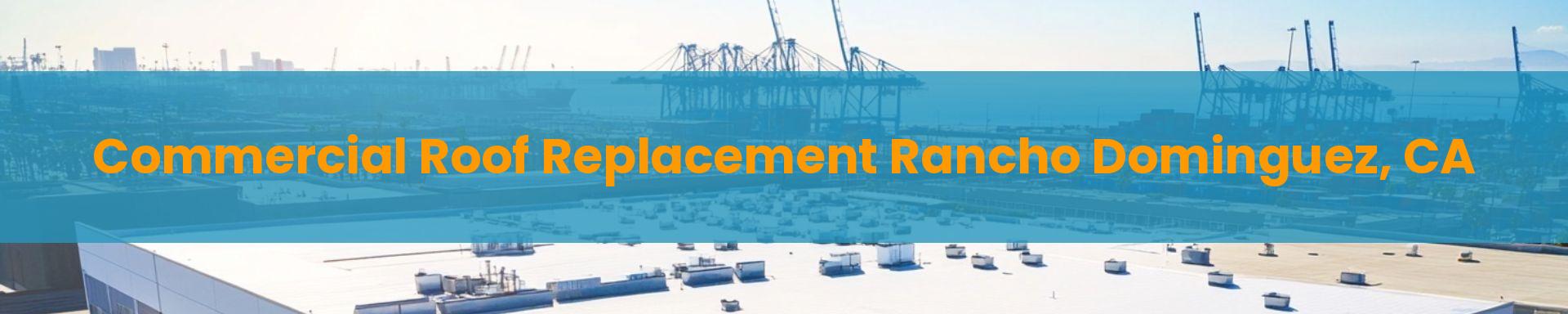
Commercial Roofing Long Beach delivers system-led commercial roof replacement in Rancho Dominguez, California by removing failed, saturated, deteriorated, freight-exposed, contaminant-affected, incompatible, overloaded, or end-of-service-life roof assemblies and installing replacement roof systems for warehouse buildings, logistics facilities, distribution centres, manufacturing properties, contractor yards, storage buildings, automotive facilities, light industrial units, office-warehouse spaces, service-based commercial buildings, and other commercial facilities. Commercial Roofing Long Beach scopes commercial roof replacement in Rancho Dominguez around verified roof failure, South Bay industrial exposure, Alameda Street goods-movement activity, Del Amo Boulevard industrial frontage, Santa Fe Avenue corridor pressure, Wilmington Avenue access movement, Victoria Street property circulation, Central Avenue industrial influence, Dominguez Rancho Adobe area proximity, Alameda Corridor freight activity, 710 Freeway connectivity, 91 Freeway regional movement, 405 Freeway access, port-adjacent logistics demand, Southern California UV load, coastal-inland temperature movement, rooftop equipment layout, insulation condition, drainage performance, attachment requirements, deck stability, recover eligibility, code constraints, access sequencing, tenant continuity, loading-area movement, yard circulation, and long-term building use, ensuring the replacement roof is designed around actual performance demand rather than like-for-like material substitution, repeated patching, or premature coating.
The Rancho Dominguez-specific replacement outcomes below show how commercial roof replacement scope is converted into tear-off decisions, substrate review, insulation correction, drainage alignment, replacement system selection, interface rebuilding, and documented closeout across freight-served industrial parcels, warehouse roof spans, distribution buildings, manufacturing properties, contractor-yard sites, Alameda Corridor goods-movement exposure, Del Amo Boulevard industrial activity, Santa Fe Avenue corridor residue, loading-zone roof edges, rooftop mechanical concentration, low-slope roof assemblies, sustained UV exposure, coastal-inland heat cycling, paved-yard sediment, truck-route particulates, and intermittent storm-season rainfall.
- Commercial roof replacement scope confirmation in Rancho Dominguez → membrane fatigue, recurring leak history, lap separation, flashing movement, penetration deterioration, drainage restriction, rooftop equipment wear, freight-related roof-surface residue, industrial contamination, insulation saturation, attachment weakness, deck movement, and end-of-service-life roof decline are tested against actual roof-system behaviour → commercial roof replacement is aimed at verified assembly failure rather than cosmetic weathering, tenant-reported leaks, ceiling staining, yard-debris symptoms, freight-residue buildup, or short-term repair signals.
- Tear-off exposure and substrate readiness in Rancho Dominguez → failed membranes, abandoned repair layers, wet insulation, deteriorated flashings, freight-exposed surfaces, incompatible roof materials, overloaded roof build-ups, contaminated roof areas, soft substrate zones, corrosion-prone components, and unsuitable recover conditions are removed, opened, or investigated before replacement materials are installed → the new commercial roof assembly is placed over a prepared base capable of supporting attachment, drainage control, waterproofing continuity, freight-corridor exposure, industrial yard activity, and long-term roof performance.
- Insulation correction and drainage recalibration for Rancho Dominguez buildings → saturated, compressed, displaced, contaminated, heat-aged, dust-loaded, residue-affected, or underperforming insulation is replaced or upgraded alongside drain, scupper, gutter, slope, ponding, loading-area runoff, roof-edge, and low-slope water-flow requirements → the replacement roof supports thermal stability, moisture control, drainage performance, code alignment, rooftop equipment durability, and compatibility with the selected commercial roof system.
- Replacement system matching for Rancho Dominguez commercial roof conditions → TPO, PVC, EPDM, metal roofing, built-up roofing, modified bitumen, recover, or full tear-off replacement strategies are matched to roof span, deck condition, rooftop equipment layout, industrial exposure, logistics activity, distribution demand, manufacturing use, contractor-yard movement, Alameda Street freight influence, Del Amo Boulevard industrial frontage, Santa Fe Avenue corridor pressure, Wilmington Avenue access routes, Alameda Corridor goods movement, 710 Freeway connectivity, 91 Freeway regional movement, 405 Freeway access, heat load, UV exposure, membrane condition, drainage behaviour, attachment requirements, and lifecycle expectations → the replacement roof is selected for verified Rancho Dominguez performance risk rather than default material substitution.
- Edge, flashing, penetration, and equipment-zone rebuilding during Rancho Dominguez roof replacement → parapets, curbs, vents, skylights, HVAC penetrations, exhaust openings, pipe supports, conduit runs, service entries, wall transitions, drains, scuppers, gutters, roof edges, perimeter transitions, loading-area edges, yard-facing roof edges, and equipment-adjacent details are rebuilt where thermal movement, rooftop service traffic, truck-route vibration, freight-related particulate load, paved-yard debris, industrial residue, port-adjacent contamination, and low-slope drainage pressure create future ingress risk → replacement scope restores waterproofing continuity at the interfaces where Rancho Dominguez commercial roof failure is most likely to concentrate.
- Replacement closeout record for Rancho Dominguez commercial properties → roof condition findings, tear-off notes, insulation decisions, substrate preparation, deck observations, installed system details, drainage corrections, flashing reconstruction, rooftop equipment-zone work, industrial-exposure notes, freight-corridor observations, loading-area notes, yard-access notes, inspection results, warranty-relevant records, maintenance recommendations, and completion status are documented for owners, property managers, facility teams, tenants, insurers, and asset-planning requirements → handover, maintenance planning, claim support, warranty continuity, future budgeting, operational review, loading-area planning, yard-access planning, and long-term commercial roof asset control are supported.
What Commercial Roof Replacement Services Do We Provide In Rancho Dominguez, CA?
Commercial Roofing Long Beach delivers system-led commercial roof replacement across Long Beach, the Los Angeles Harbor area, nearby South Bay communities, and Gateway Cities commercial districts by removing failed, saturated, incompatible, salt-exposed, contaminant-affected, or end-of-service-life roof assemblies and installing replacement roof systems for port-adjacent buildings, logistics facilities, warehouses, manufacturing properties, waterfront commercial assets, hospitality buildings, restaurants, retail centres, offices, medical properties, multifamily buildings, and mixed-use facilities. Commercial roof replacement is scoped around verified roof failure, marine-air exposure, Port of Long Beach goods-movement activity, Southern California UV load, drainage behaviour, insulation condition, rooftop equipment layout, attachment requirements, structural deck condition, recover eligibility, code constraints, access sequencing, tenant continuity, loading-zone movement, and long-term building use, so the replacement system is selected for actual performance demand rather than like-for-like material substitution, repeated leak patching, or premature coating.
- Commercial Roof Replacement → membrane fatigue, repeated leak history, drainage failure, insulation saturation, substrate weakness, attachment failure, salt-air exposure, port-adjacent contamination, or system-wide ageing → full roof replacement is used when repair, coating, or localized patching is no longer a dependable roof-management strategy.
- Flat Roof Replacement → ponding water, open laps, failed flashings, saturated insulation, soft substrate zones, restricted drains, clogged scuppers, roof-edge weakness, or broad membrane deterioration → the low-slope assembly is replaced so waterproofing, drainage, slope, insulation, and discharge performance can be rebuilt as one system.
- TPO Roof Replacement → reflective TPO membrane, heat-welded seams, compatible insulation, secure terminations, penetration detailing, perimeter attachment, and drainage-aware layout → a replacement system is installed for Long Beach commercial roofs exposed to solar load, coastal UV stress, rooftop equipment demand, port-area particulates, and temperature movement.
- PVC Roof Replacement → welded seam reliability, chemical resistance, grease tolerance, moisture control, rooftop equipment compatibility, and low-slope waterproofing performance → PVC replacement is used for restaurants, hospitality buildings, industrial properties, port-adjacent facilities, and contaminant-exposed commercial roofs.
- EPDM Roof Replacement → shrinkage, seam separation, puncture damage, flashing failure, edge movement, membrane thinning, rooftop traffic, or thermal expansion and contraction → the rubber membrane assembly is replaced when waterproofing continuity can no longer be restored through repair.
- Metal Roof Replacement → panel distortion, corrosion, fastener withdrawal, seam separation, flashing breakdown, coating loss, oil-canning, salt-air exposure, or movement-related failure → the metal roof system is replaced when weather resistance, attachment stability, and roof-system integrity have broken down.
- Built-Up Roof Replacement → blistering, cracking, surfacing loss, moisture intrusion, interply weakness, edge failure, alligatoring, ponding exposure, marine-air ageing, or long-term heat exposure → the BUR assembly is replaced when its multi-layer waterproofing redundancy has lost dependable value.
- Modified Bitumen Roof Replacement → split seams, granule loss, surface deterioration, movement cracking, flashing failure, ponding exposure, membrane fatigue, rooftop equipment stress, or repeated leak recurrence → the reinforced asphalt membrane system is replaced when end-of-service-life failure is confirmed.
- Commercial Roof Tear-Off → failed membranes, abandoned repair layers, wet insulation, deteriorated flashings, incompatible materials, overloaded build-ups, salt-affected components, contaminated surfaces, or unsuitable recover conditions → defective roof layers are removed so the replacement assembly can be installed over a verified substrate.
- Roof Insulation Replacement → saturated, compressed, damaged, displaced, contaminated, or underperforming insulation → insulation is replaced or upgraded to restore assembly stability, thermal performance, drainage support, code alignment, moisture control, and replacement-system compatibility.
- Roof Deck Assessment And Preparation → rust, moisture damage, deflection, fastener withdrawal, weak substrate zones, damaged sheathing, attachment limitations, load concerns, corrosion exposure, or structural issues → the deck is verified and prepared before the new commercial roof assembly is installed.
- Commercial Roof Recover Evaluation → existing roof condition, trapped moisture risk, insulation stability, deck capacity, drainage performance, attachment requirements, added load, material compatibility, coastal exposure, port-adjacent contamination, and code limitations → recover viability is confirmed before choosing between overlay and full tear-off replacement.
Have a question about a commercial roof replacement project?
When Does A Rancho Dominguez Commercial Roof Need Replacement Instead Of Repair?
Commercial roof replacement in Rancho Dominguez is required when roof-level investigation shows that the existing assembly can no longer preserve waterproofing continuity, evacuate rainfall from low-slope industrial roof areas, withstand South Bay heat movement, resist Southern California UV load, support rooftop mechanical equipment, or remain dependable under freight-served warehouse, distribution, manufacturing, contractor-yard, storage, automotive, and office-warehouse operating conditions. Across Rancho Dominguez commercial properties, including warehouse buildings, logistics facilities, distribution centres, manufacturing properties, contractor yards, storage buildings, automotive facilities, light industrial units, office-warehouse spaces, and service-based commercial buildings, replacement becomes necessary where membrane failure, recurring water entry, saturated insulation, flashing movement, weak deck conditions, attachment loss, freight-corridor contamination, paved-yard residue, or unsuitable recover conditions show that patching, coating, or partial restoration would only keep a failing roof assembly temporarily serviceable.
The Rancho Dominguez-specific replacement triggers below show when a commercial roof has moved beyond repairable defect control and requires commercial roof replacement.
- End-of-service-life membrane condition. UV exposure, coastal-inland heat movement, surface splitting, shrinkage, blistering, lap fatigue, coating erosion, puncture damage, rooftop traffic, freight residue, or broad membrane brittleness → the roof covering can no longer behave as a dependable waterproofing layer → commercial roof replacement becomes necessary when the membrane field cannot be restored through isolated section repair.
- Recurring water entry after patching, coating touch-ups, or sealant work. Failed repairs around membrane laps, flashing returns, roof penetrations, drain bowls, scupper openings, parapet details, wall transitions, gutter lines, rooftop equipment curbs, loading-area edges, or yard-facing perimeter terminations → the active defect remains distributed through the roof assembly instead of being limited to one visible leak point → replacement is required when localized repair no longer corrects the actual Rancho Dominguez roof-system failure.
- Drainage failure creating ponding, saturation, or repeated moisture loading. Restricted drains, blocked scuppers, clogged gutters, shallow slope, paved-yard sediment, truck-route dust, freight-corridor residue, industrial debris, roof-level buildup, loading-zone runoff, or intermittent storm-season rainfall → retained water increases membrane fatigue, insulation risk, flashing pressure, concealed deck load, and recurring leak probability → replacement becomes necessary when drainage performance must be rebuilt into the roof assembly, insulation layout, and discharge strategy.
- Roof insulation that is wet, compressed, displaced, or no longer supporting the assembly. Saturated, compressed, damaged, residue-affected, or displaced insulation below the membrane surface → leak cycles remain active, drainage behaviour becomes uneven, thermal performance declines, concealed load increases, adhesion weakens, and new membrane performance is compromised → replacement is required where insulation must be exposed, removed, upgraded, or reconfigured before the roof can perform reliably.
- Heat movement damaging laps, roof edges, fasteners, and flashing details. Rancho Dominguez heat cycles, warehouse roof spans, distribution-building movement, rooftop equipment demand, contractor-yard activity, loading-area vibration, and office-warehouse use pull at membrane laps, curb flashings, perimeter edges, attachment points, equipment transitions, gutter-adjacent terminations, wall tie-ins, and yard-facing edges → movement-related weakness spreads through the commercial roof assembly → commercial roof replacement becomes necessary when the failure is no longer limited to one repairable detail.
- Flashing, penetration, gutter, and perimeter failure across the wider roof system. Parapets, curbs, vents, skylights, HVAC penetrations, exhaust openings, pipe supports, conduit runs, service entries, wall transitions, drains, scuppers, gutters, roof edges, loading-area returns, yard-facing perimeters, and equipment-adjacent details lose continuity under ageing, rooftop traffic, wind-driven rain, vibration, UV exposure, heat movement, freight residue, and high-use industrial conditions → water can bypass the intended drainage route and enter through vulnerable roof interfaces → replacement is required when these details must be rebuilt as part of a new roof assembly rather than resealed individually.
- Distribution, contractor-yard, logistics, and rooftop equipment zones repeatedly weakening the roof assembly. Warehouse ventilation, industrial exhaust, HVAC curbs, condenser platforms, pipe supports, equipment pads, service routes, roof hatches, loading-zone details, access paths, contractor-yard exposure, and maintenance zones → contamination, abrasion, punctures, compression, vibration wear, flashing gaps, and repeat leak points develop around service-heavy roof areas → replacement becomes necessary when equipment-zone protection, compatible surfaces, walk pads, curbs, penetrations, and service detailing must be built into the replacement design.
- Alameda Street, Del Amo Boulevard, Santa Fe Avenue, Wilmington Avenue, Victoria Street, Central Avenue, Alameda Corridor, 710 Freeway, 91 Freeway, 405 Freeway, and Dominguez Rancho Adobe area exposure accelerating deterioration. Freight particulates, truck-route dust, freeway residue, paved-yard buildup, loading-zone sediment, industrial airborne debris, port-adjacent contamination, rail-corridor residue, and yard-facing debris → membrane abrasion, drainage clogging, shortened coating life, contaminated roof details, higher moisture loading, and increased leak risk around drains, scuppers, gutters, penetrations, roof edges, and rooftop equipment zones → replacement is required when local industrial, freight, and corridor exposure have become part of the roof-system failure rather than a surface maintenance issue.
- Deck or substrate weakness below the roof system. Moisture damage, soft substrate zones, deck deflection, deteriorated sheathing, fastener withdrawal, weak attachment points, contaminated surfaces, corrosion-prone components, vibration-affected equipment areas, loading-zone stress, yard-facing exposure, or unstable base conditions → continued surface repair cannot provide dependable replacement performance → replacement is required where the roof assembly must be opened, verified, prepared, and corrected before new materials are installed.
- Recover unsuitability because concealed risk remains too high. Trapped moisture, excessive roof layers, poor drainage, unstable insulation, incompatible materials, deck-capacity limits, attachment limitations, freight contamination, paved-yard residue, rooftop equipment movement, or code restrictions → a reliable overlay cannot be justified → commercial roof replacement becomes necessary when full tear-off is the responsible route to remove hidden failure and install a verified assembly.
- Operational, insurance, energy, or lifecycle requirements exceeding the existing roof. Warehouse buildings, logistics facilities, distribution centres, manufacturing properties, contractor yards, storage buildings, automotive facilities, light industrial units, office-warehouse spaces, and service-based commercial buildings with higher tenant, equipment, energy, maintenance, goods-movement, loading-access, inventory-protection, storm-readiness, insurance, or asset-planning demands → the existing roof can no longer support the building’s required performance profile → replacement becomes necessary when continued repair cannot meet operational and lifecycle expectations.
In Rancho Dominguez, commercial roof replacement becomes necessary once investigation confirms that membrane deterioration, recurring water entry, drainage failure, insulation saturation, heat-movement damage, flashing separation, rooftop equipment wear, freight-corridor contamination, paved-yard residue, deck instability, recover unsuitability, or obsolete roof configuration cannot be corrected through continued patching, coating, or partial restoration, making replacement the responsible pathway for restoring controlled, durable, and performance-aligned commercial roof protection.
Have a question about a commercial roof replacement project?
Which Rancho Dominguez Roof Failures Make Commercial Roof Replacement The Responsible Route?
Commercial roof replacement in Rancho Dominguez resolves roof-system failure where depleted membrane fields, recurring water entry, heat-driven roof movement, low-slope drainage failure, wet insulation, failing roof interfaces, freight-corridor contamination, rooftop equipment-zone deterioration, attachment weakness, substrate instability, recover limitations, paved-yard debris exposure, loading-area roof stress, or obsolete roof configuration prevent a commercial roof from remaining dependable under South Bay heat, Southern California UV exposure, warehouse activity, logistics movement, distribution demand, manufacturing use, contractor-yard operation, automotive service conditions, and intermittent storm-season rainfall. Across Rancho Dominguez commercial properties, including warehouse buildings, logistics facilities, distribution centres, manufacturing properties, contractor yards, storage buildings, automotive facilities, light industrial units, office-warehouse spaces, and service-based commercial buildings, replacement becomes the system-level pathway where repair, coating, isolated flashing work, or partial restoration can no longer correct the underlying roof assembly failure.
The Rancho Dominguez-specific roof replacement problems below show what commercial roof replacement solves when the existing commercial roof has moved beyond repairable defect control.
- End-of-life membrane deterioration across freight-served industrial roof spans. Alameda Street goods-movement activity, Del Amo Boulevard industrial frontage, Santa Fe Avenue corridor pressure, Wilmington Avenue access movement, Victoria Street property circulation, Central Avenue industrial influence, Alameda Corridor freight activity, 710 Freeway, 91 Freeway, and 405 Freeway particulates, port-adjacent logistics demand, Southern California UV load, lap fatigue, surface cracking, shrinkage, blistering, coating erosion, puncture damage, rooftop traffic, and repeated heat cycling → the existing membrane can no longer function as a continuous waterproofing layer → commercial roof replacement solves this by removing the failed roof covering and installing a new assembly selected for verified roof span, freight exposure, building use, drainage behaviour, and lifecycle requirements.
- Recurring leaks after patching, coating, or sealant work. Water entry returns after repeated repair attempts around membrane laps, roof drains, scuppers, gutters, parapet returns, wall transitions, HVAC curbs, roof edges, loading-area details, yard-facing terminations, service penetrations, or rooftop equipment zones → the active failure is distributed through the membrane field, flashing network, drainage layout, insulation condition, attachment pattern, rooftop equipment detailing, or substrate condition → commercial roof replacement solves this by replacing the failed roof assembly instead of extending another short repair cycle.
- Heat-movement damage across Rancho Dominguez low-slope commercial roof assemblies. Warehouse, logistics, distribution, manufacturing, contractor-yard, automotive-service, light industrial, office-warehouse, storage, and service-business roof spans expand and contract under Rancho Dominguez heat cycles, rooftop equipment loads, truck-route vibration, freight activity, and industrial building movement → seams, membrane laps, roof edges, curb flashings, fasteners, loading-area terminations, wall tie-ins, and rooftop equipment transitions are pulled out of stable alignment → replacement solves this by rebuilding the assembly with compatible materials, secure attachment, reinforced terminations, and movement-aware detailing.
- Drainage failure caused by paved yards, freight residue, and low-slope industrial geometry. Restricted drains, blocked scuppers, clogged gutters, shallow roof slope, truck-route dust, loading-zone sediment, contractor-yard debris, industrial residue, paved-yard buildup, port-adjacent particulates, rail-corridor dust, roof-level debris, and intermittent rainfall → water remains on the roof surface and increases membrane stress, insulation risk, flashing pressure, concealed deck load, and recurring leak probability → commercial roof replacement solves this by correcting the roof build-up, insulation layout, drainage slope, outlet relationship, gutter performance, and discharge path before the new waterproofing system is installed.
- Saturated or unstable insulation beneath the membrane. Wet, compressed, displaced, contaminated, heat-aged, freight-residue-affected, dust-loaded, or thermally underperforming insulation → concealed moisture, distorted drainage, reduced energy performance, added load, weakened attachment, and unreliable surface repair remain inside the roof assembly → commercial roof replacement solves this by removing compromised insulation and rebuilding the roof assembly with stable, compatible insulation that supports code alignment, drainage control, equipment-zone durability, and long-term performance.
- Flashing failure at Rancho Dominguez commercial roof junctions. Parapets, curbs, vents, skylights, wall transitions, drains, scuppers, gutters, roof edges, service entries, exhaust openings, pipe supports, conduit runs, loading-area returns, yard-facing roof edges, and HVAC penetrations are stressed by heat movement, rooftop access, truck-route vibration, freight residue, paved-yard debris, port-adjacent particulates, and ageing materials → water bypasses the intended roof-surface drainage path through repeated junction failures → replacement solves this by rebuilding interface details as part of the new roof system rather than treating each flashing as a separate repair item.
- Distribution, logistics, contractor-yard, and rooftop equipment-zone deterioration. Warehouse ventilation, industrial exhaust, rooftop HVAC curbs, condenser platforms, pipe supports, equipment pads, exhaust openings, conduit supports, access paths, loading-zone roof edges, service routes, contractor-yard exposure, and maintenance zones → membrane contamination, abrasion, punctures, compression damage, flashing gaps, vibration wear, and recurring leak points develop around service-heavy roof areas → commercial roof replacement solves this by integrating curbs, penetrations, walk pads, compatible membrane selection, protection zones, and service-access detailing into the replacement design.
- Attachment failure or substrate instability below the roof assembly. Moisture damage, soft decking, deflection, deteriorated sheathing, weak substrate zones, fastener withdrawal, contaminated surfaces, corrosion-prone components, vibration-affected areas, loading-zone stress, yard-facing exposure, or attachment limitations → the base condition cannot support dependable replacement performance if it remains hidden beneath surface repairs → replacement solves this by exposing, verifying, preparing, and correcting the deck or substrate before new roofing materials are installed.
- Recover limitations created by concealed moisture or incompatible roof build-up. Trapped moisture, too many roof layers, poor drainage, deck-capacity limits, unstable insulation, incompatible materials, freight-corridor contamination, industrial residue, paved-yard debris, rooftop equipment movement, attachment limitations, or code restrictions → overlay installation would conceal unresolved failure and increase replacement risk → commercial roof replacement solves this by determining whether recover is viable or whether full tear-off is required to remove hidden risk.
- Commercial roofs that no longer match Rancho Dominguez building use or asset requirements. Warehouses, logistics facilities, distribution centres, manufacturing properties, contractor yards, storage buildings, automotive facilities, light industrial units, office-warehouse spaces, and service-based commercial buildings face changing tenant requirements, rooftop equipment loads, energy goals, maintenance costs, insurance expectations, goods-movement demands, loading-access needs, yard logistics, inventory-protection requirements, or lifecycle risk → the original roof system no longer matches the building’s operating profile → commercial roof replacement solves this by aligning the new roof assembly with actual building operation, exposure, compliance, and long-term asset planning.
In Rancho Dominguez, commercial roof replacement resolves the roof-system failures behind end-of-life membrane deterioration, recurring leaks, heat-movement damage, drainage breakdown, insulation saturation, flashing collapse, freight-corridor contamination, rooftop equipment-zone deterioration, attachment weakness, substrate instability, recover unsuitability, paved-yard debris exposure, loading-area roof stress, and obsolete roof configuration, making replacement the responsible pathway when continued repair, coating, or partial restoration can no longer provide controlled and durable commercial roof performance.
Have a question about a commercial roof replacement project?
When Should Rancho Dominguez Property Owners Plan A Commercial Roof Replacement Assessment?
A Rancho Dominguez commercial roof should be assessed for replacement when the existing assembly can no longer keep water out, drain low-slope industrial roof areas, resist South Bay heat, or support rooftop equipment reliably. This often affects warehouse buildings, logistics facilities, distribution centres, manufacturing properties, contractor yards, storage buildings, automotive facilities, light industrial units, office-warehouse spaces, and service-based commercial buildings near Alameda Street, Del Amo Boulevard, Santa Fe Avenue, Wilmington Avenue, Victoria Street, Central Avenue, the Alameda Corridor, the 710 Freeway, the 91 Freeway, the 405 Freeway, and the Dominguez Rancho Adobe area. Replacement assessment becomes important where UV exposure, heat cycling, freight-corridor residue, port-adjacent particulates, truck-route dust, paved-yard sediment, loading-zone runoff, rooftop equipment layouts, insulation condition, drainage behaviour, or deck stability may make repair, coating, recover, tear-off, insulation replacement, or full commercial roof replacement the correct route. Where the membrane is brittle, cracked, blistered, shrunken, punctured, split at laps, worn along loading-area edges, or contaminated around exhaust and service zones, commercial roof replacement in Rancho Dominguez may be necessary because the roof covering can no longer act as a dependable waterproofing layer. Where leaks continue after patching, sealant work, coating repairs, or partial flashing correction, the failure may be spread through the membrane field, flashing network, drainage layout, insulation condition, attachment system, rooftop equipment interfaces, or supporting substrate. Where restricted drains, blocked scuppers, clogged gutters, shallow slope, paved-yard runoff, loading-zone sediment, contractor-yard debris, freight-corridor dust, port-adjacent residue, rail-corridor particulates, or intermittent rainfall causes ponding or recurring moisture exposure, replacement planning should verify whether drainage correction must be rebuilt into the new roof assembly. Where insulation is saturated, compressed, displaced, contaminated, freight-residue-loaded, heat-aged, dust-affected, or thermally weak, a new membrane cannot perform reliably over the existing roof build-up.
Where heat movement has pulled at seams, laps, fasteners, edge details, parapets, curbs, wall transitions, roof drains, scuppers, gutters, service entries, yard-facing details, conduit supports, pipe supports, or equipment penetrations, replacement assessment is needed to rebuild the roof with compatible materials, secure attachment, reinforced terminations, and movement-aware detailing. Where warehouse ventilation zones, distribution-building equipment areas, contractor-yard roof edges, HVAC curbs, pipe supports, service routes, roof hatches, skylights, vents, access paths, drains, scuppers, parapets, gutters, roof edges, wall transitions, loading-area perimeters, or industrial equipment interfaces show recurring wear, contamination, flashing separation, puncture exposure, compression damage, vibration wear, corrosion risk, or water-entry risk, coordinated replacement may be required. These details need to be integrated into the replacement system rather than resealed as isolated defects. Where deck rust, moisture damage, soft substrate zones, fastener withdrawal, deflection, deteriorated sheathing, contaminated base layers, load concerns, vibration-affected areas, loading-zone stress, yard-facing exposure, or attachment limitations exist beneath the visible roof surface, the deck must be verified before replacement materials are installed. Where recover is being considered, the assessment must check trapped moisture, added load, code limitations, poor drainage, unstable insulation, material incompatibility, freight-corridor contamination, paved-yard residue, port-adjacent particulates, attachment weakness, yard-access constraints, and deck capacity. Commercial Roofing Long Beach assesses Rancho Dominguez commercial roofs against verified replacement evidence. The correct pathway is determined by roof age, failure history, membrane condition, insulation moisture, drainage behaviour, rooftop equipment layout, deck stability, recover eligibility, code constraints, access sequencing, tenant continuity, loading access, goods movement, yard logistics, and long-term facility needs. If your building in Rancho Dominguez has recurring leaks, end-of-life membrane deterioration, saturated insulation, ponding water, flashing failure, freight-corridor contamination, contractor-yard roof wear, rooftop equipment-zone damage, deck concerns, unsuitable recover conditions, or uncertainty over whether repair or coating can remain dependable, request a commercial roof replacement assessment to identify the correct replacement, recover, tear-off, insulation, drainage, and deck-preparation pathway.
Have a question about a commercial roof replacement project?